How to build AI agents that survive production
Most agent demos never reach production. The discipline that separates demos from dependable systems: tool contracts, evals, tracing and graceful failure.
By PixnMind · · 7 min read
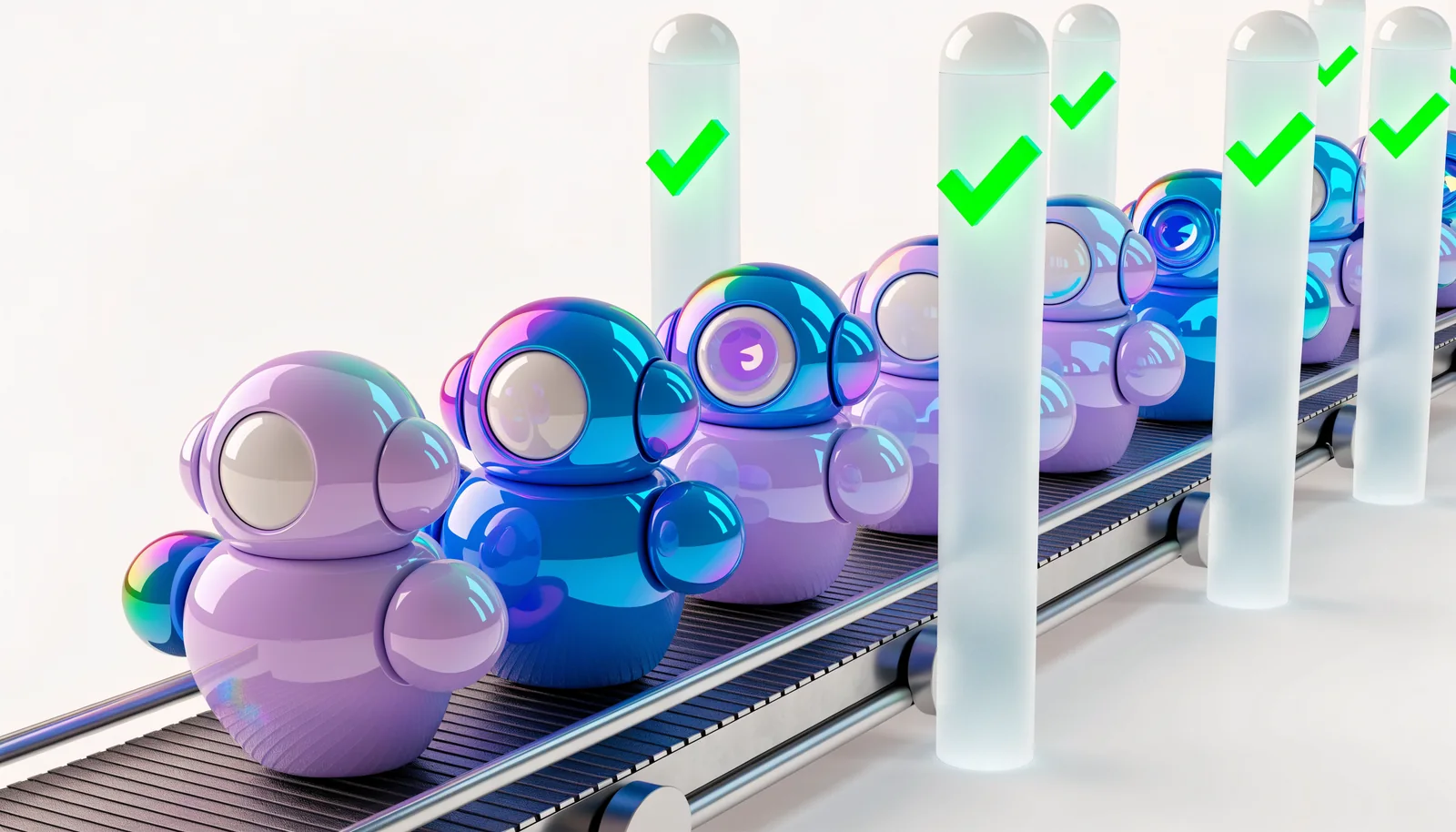
Every team building with large language models has the same experience. The first demo is magical. The second week reveals the agent occasionally invents a tool argument, loops forever on an ambiguous request, or confidently returns something that looks right and is not. The difference between a demo and a product is what you do about that.
1. Treat tools as contracts, not suggestions
An agent is only as reliable as the surface it acts on. Every tool we expose has a strict schema, exhaustive validation and idempotent semantics wherever a retry is possible. When a call fails, the error message is written for the model, not the developer: it explains what was wrong and what a valid call looks like. Reliability improves dramatically once tools stop being ambiguous.
2. Build the eval suite before the feature
You cannot improve what you cannot measure. Before we ship an agent we assemble a set of realistic tasks with expected outcomes, then run every prompt and model change against it. The suite grows with every production failure. This turns model upgrades from a gamble into a measured decision.
3. Trace everything
When a user reports a bad answer, you need to see every step: the retrieved context, each tool call, the model's reasoning and the latency and cost of each hop. We instrument agents with structured traces from day one. It is the single highest-leverage investment for debugging and for controlling cost.
4. Design for graceful failure
- Bounded loops: a maximum number of steps and a budget per task.
- Fallbacks: a simpler model, a cached answer, or an honest "I could not do this".
- Human checkpoints where the cost of a wrong action is high.
- Clear UI states so users know when the system is uncertain.
5. Keep the user in the loop
The best agents show their work. Streaming intermediate steps, citing sources and asking one clarifying question at the right moment do more for trust than any amount of raw capability. Intelligence that users cannot understand is intelligence they will not adopt.
At PixnMind this discipline is baked into how we build. If you are moving an agent from prototype to production, we would love to compare notes.